If you are interested here is the accompanying paper explaining the painting.
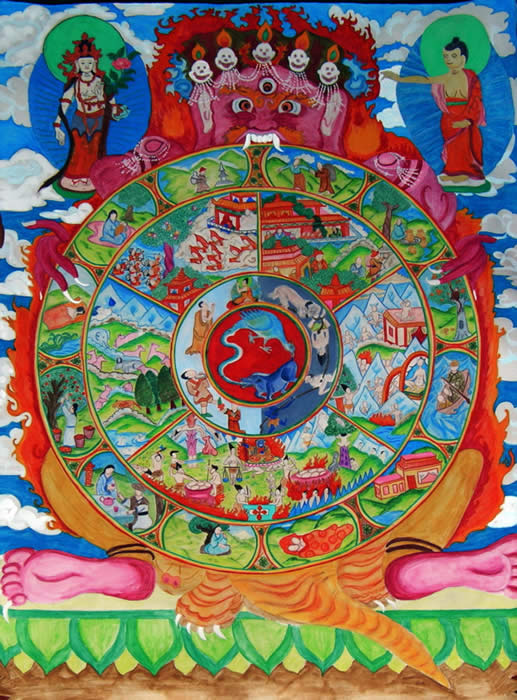
This is a Tibetan Wheel of Existence, also known as a Bhadracakra, which symbolizes the Buddhist perspective on life, and illustrates the endless life cycle of humans. Yama, Lord of the Dead, holds the wheel. He is the symbol of the transitory nature of all earthly phenomena.
Starting in the center is the three spiritual poisons; ignorance, envy/hatred, and lust/greed represented by the pig, the snake and the cock. Each is biting the others tails to signify that these evils are inseparably connected. These three poisons drive the unenlightened life cycle.
In the next circle the light half on the left shows figures ascending to higher levels of existence, the dark half on the right shows figures descending to lower levels.
The six main segments of the wheel depict the six worlds or realms of existence. These six realms constitute all possible states of existence in the universe and all beings cycle between these states depending on their karma. None of these states are permanent or everlasting. They are from the top going clockwise:
- The World of Men – driven by egoism and ignorance, they suffer from the repeated cycle of rebirth, sickness, and death. A Buddha with a begging bowl appears to help them.
- The World of Hungry Ghosts - this world is the realm of insatiable, greedy ghosts, suffering from hunger and thirst, which they cannot appease nor quench.
- The World of Hells – This is the world of the cold and hot hells, places of torment for all those who have committed evil deeds out of hatred and anger. While this life is long, it is not eternal. After atoning for sins, rebirth into a better life is possible. Here there is an assistant to the Lord of the Dead (center left) who weighs the deeds of the deceased entering. There is an appearance of a Buddha, bearing a flame, to bring light and hope even to this dark region.
- The World of Animals – illustrates their special suffering; oppression by other beings. They devour each other and become beasts of burden.
- The World of Titans and the World of Gods – The Titans are always fighting against the gods for fulfillment of there own desires; their suffering is the endless war, the result of envy and insatiable ambition. The Gods are in a temporal paradise achieved by good deeds, but they are not yet freed from sorrow. They too are subject to old age and death. Their special suffering is the illusion of paradise; the misery lies in their eventual comprehension of the error.
The final circle of the Wheel of Existence is divided into twelve sections, each depicting a phase of the peculiar cycle of cause and effect which keeps one trapped in the above six realms. They are again from the top going clockwise:
- Ignorance – illustrated by an old and sightless man unable to find his way home without help.
- Volitional Activities – represented by a potter, his pots being symbolic of his own deeds (acting, speaking, thinking), which he moulds to his own karma.
- Sentience – depicts a tree and a monkey partially eating fruit before moving to the next piece, symbolizing the major consciousness in which ignorant people spring uncontrolled from object to object.
- Name and Form – illustrated by two men riding in a boat representing mind and body, while a third, more imposing then them (the mind body composite), rows and steers the boat.
- The Sense Organs – a house with five windows and a door, symbolizing the five senses and the faculty of thinking which perceives the outer world.
- Sensuous Impressions - depicted by a man and woman embracing, demonstrating contact.
- Feeling – A man with an arrow in his eye, illustrating the emotions by which one is struck.
- Craving – A woman offering a man a drink illustrates desire, stimulated by perceptions and emotions leading to a ‘thirst for life’.
- Grasping – a woman plucking fruit from a tree illustrates sexual entanglement; the longing to keep that which is desired.
- Bringing into Existence – a couple making love symbolizing the procreation of new life.
- Birth – After procreation, this is the episode of giving birth, the cycle of life continues.
- Death and Decay – this last picture shows old age and death, the inevitable end of all earthly existence, illustrated by a man, carrying a corpse on his back, to its final resting place.
The Buddha appears outside the wheel, in the top right corner, who taught men how to be free. Avalokiteshvara,the Bodhisttva of Compassion, in the top left corner, helps men to become free.